The Internet and Its Discontents

One young woman claims to know what is wrong with girls today: They need to turn to the right.
https://prospect.org/2026/06/05/jun-2026-internet-and-its-discontents-india-review/
 Credit: Illustration by Lindsay Ballant. Source: Laura Chouette/Unsplash.
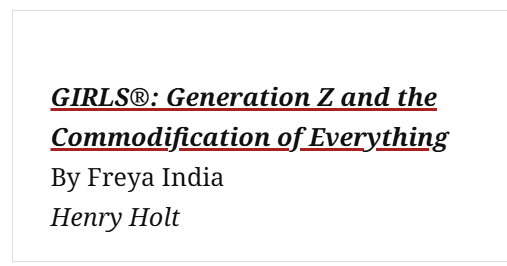
Freya India is worried about the girls. Girls®, to be more precise. “We have been transformed from people into products,” the blurb of her book,
GIRLS®: Generation Z and the Commodification of Everything, claims. The “we” she is invoking allegedly includes herself; India, the 26-year-old writer behind the popular Substack newsletter
GIRLS and staff writer at Jonathan Haidt’s publication
After Babel, began writing what would eventually become this book in 2021 to “figure out why [she] felt so anxious and alone.” Over time, she explains at the start of the book, she came to the conclusion that the internet was the problem, and the incentive structure that young women have online is making them more anxious, more alone, and more disconnected than ever.

Anyone who has ever been on the internet over the past ten years is likely to sympathize with this line of thinking. The race-to-the-bottom ad monetization strategy of Meta, Google, and the winners of Silicon Valley’s platform era turned tech founders into the richest people alive. It incentivizes certain types of user behavior that perform well on algorithms to the detriment of fostering human connection. At first glance, India is the latest in a long line of critics bemoaning the encroachment of extractive tech companies into every layer of society.
However, is this what India is really interested in? The book is structured into an introduction, six chapters with pithy names—“Filtered,” “Diagnosed,” “Documented,” “Disconnected,” “Detached,” and “‘Empowered’”—each diagnosing a different issue that girls on the internet face, and a conclusion detailing her prescription for these ills. India has marketed this book as a treatise against Big Tech, presumably because Silicon Valley is a well-documented villain that everyone can agree on.
But her diagnoses of both the problem and the solution have little to do with tech companies. While the book is nominally a work of tech criticism, she has far harsher verdicts on divorce, hookup culture, the retreat of organized religion, and porn. Mark Zuckerberg comes in for less scrutiny for intentionally stoking body dysmorphia among teen girls on Instagram than do the cultural bogeymen of the right. “For decades,” she writes, “the institutions, communities, and customs that once bound people together have been falling away. Religion has more or less disappeared, marriage and family have been mocked, neighborhoods have been uprooted, communities have collapsed.” She does not explain what, if anything, this has to do with “the commodification of everything.”
snip
