Environment & Energy
Related: About this forum"Effectively Irreversible" Change Makes Biscayne Bay Much More Like Open Ocean Than In Recent Past - More Acidic, Saline
EDIT
In the shadow of Miami’s skyline, in water churned daily by boats and jet skis, juvenile great hammerhead sharks—a critically endangered species—spend the first two years of their lives. A few miles from downtown, researchers recently pulled a 12-foot critically endangered sawfish from the same shallows. The species has been dying off in alarming numbers across South Florida’s waters since 2024, in an event scientists suspect was set in motion by record ocean heat. The bay teems with life most of the city never registers: more than 30 endangered or imperiled species and over 100 that matter to commercial and recreational fishing. Yet when researchers surveyed more than 1,000 Miami-Dade residents, most rated the bay as “moderately healthy,” even as its water quality had measurably declined and a government assessment warned the estuary had reached “a tipping point.”
It is also changing in ways almost no one can see.Over the past two decades, the bay has grown warmer, saltier and more acidic, according to a new University of Miami study that analyzed 20 years of monthly water quality readings. The shifts are real but gradual—too slow for even the divers, anglers and scientists who spend their lives on the water to see directly. “Since I have been here, the bay has been salty,” said Ana Zangroniz, a Florida Sea Grant agent who has worked on the bay since 2017, describing change so incremental it goes unnoticed.
What the eye misses, the data captures: a bay sliding steadily from an estuary to something closer to the open ocean, a transition the study’s authors say sea-level rise has made effectively irreversible. The bay’s fish are already registering the shift. Joseph Serafy, a NOAA research fishery biologist who has tracked Biscayne Bay fish communities for two decades, has watched the catch change as the water grows saltier. Snook, seatrout and mullet—species that thrive where fresh and salt water mix—have declined, he said, while fish that tolerate a wide range of salinity, like gray snapper and grunts, hold on. It is the signature of a bay tilting away from its estuarine past: As the brackish conditions vanish, so do the creatures built for them.
EDIT
But the slow climb in averages is not what worries Serafy most. It masks a more dangerous trend of sharper, more frequent extremes. Cold snaps, heat waves, stretches of hypersalinity and sudden crashes in oxygen do the real damage, and a warmer, saltier baseline makes each spike more punishing, according to Serafy. The summer of 2023 showed what that looks like. A marine heat wave drove water temperatures off South Florida to levels never before recorded, including a reading of 101 degrees Fahrenheit in shallow Manatee Bay that may have been the hottest seawater ever measured. The region’s coral reef was bleached from end to end. Warm water holds less oxygen; so does salty water. When both climb at once and seagrass dies back, fish can suffocate, the mechanism behind die-offs that Manatee Bay had seen before.
EDIT
https://insideclimatenews.org/news/11062026/miami-biscayne-bay-sea-level-rise-threatens-sharks-and-aquifer/
 = new reply since forum marked as read
Highlight:
NoneDon't highlight anything
5 newestHighlight 5 most recent replies
= new reply since forum marked as read
Highlight:
NoneDon't highlight anything
5 newestHighlight 5 most recent replies

OKIsItJustMe
(22,328 posts)
dedl67
(271 posts)
hatrack
(65,286 posts)Hardly anybody ever even talks about it, but it's arguably the most critical long-term trend - not just the loss of marine protein, but failure of planetary oxygen production from a plankton dieoff.
OKIsItJustMe
(22,328 posts)
The 2025 update to the Planetary boundaries. Licensed under CC BY-NC-ND 3.0. Credit: "Azote for Stockholm Resilience Centre, based on analysis in Sakschewski and Caesar et al. 2025".
OKIsItJustMe
(22,328 posts)1 Physical trends
Ocean temperature (including ocean heat content)
The great capacity of the ocean to capture and store heat moderates the temperature of the planet. Over 90% of the heat absorbed by the Earth since 1955 has been accumulated in the oceans. Figure I (a) illustrates the heat increase in the upper 2,000 m of the ocean since 1955 and shows a continuous rise that peaks in 2023 Ref 48. Some 16% of this increase occurred between 2018 and 2023 even though those years represent only 7% of the time period. This heat energy accounts for 30 to 50% of sea level rise in the ocean through thermal expansion. In addition, warming contributes to changes in the migration of oceanic species, damage to coral reef systems and the accelerated melting of ice sheets (see sect. 4, subchap. 5K; and subsect. 5B, chap. 4). While the Pacific Ocean holds the largest heat reservoir due to its vast size, the greatest warming has been observed in most of the Atlantic Ocean and in the parts of the South Ocean adjacent to the Indian and Western Pacific Oceans (see figure I (b)), with notable cooling regions observed in the North Atlantic (~ 50-70º N) and in the North-West and South-West Pacific Ref 6 Ref 48. The ocean surface is where the most important heat exchange between the ocean and the atmosphere occurs. Shifts in sea surface temperature translate to important differences in water evaporation rates, atmospheric heating and cooling, marine heat waves and the thawing of sea ice, in addition to broader impacts on continental climate, as discussed in the second World Ocean Assessment.
Figure I. (a) Global mean ocean heat content (0–2,000 m); (b) Regional trends of ocean heat content (0–2,000 m)
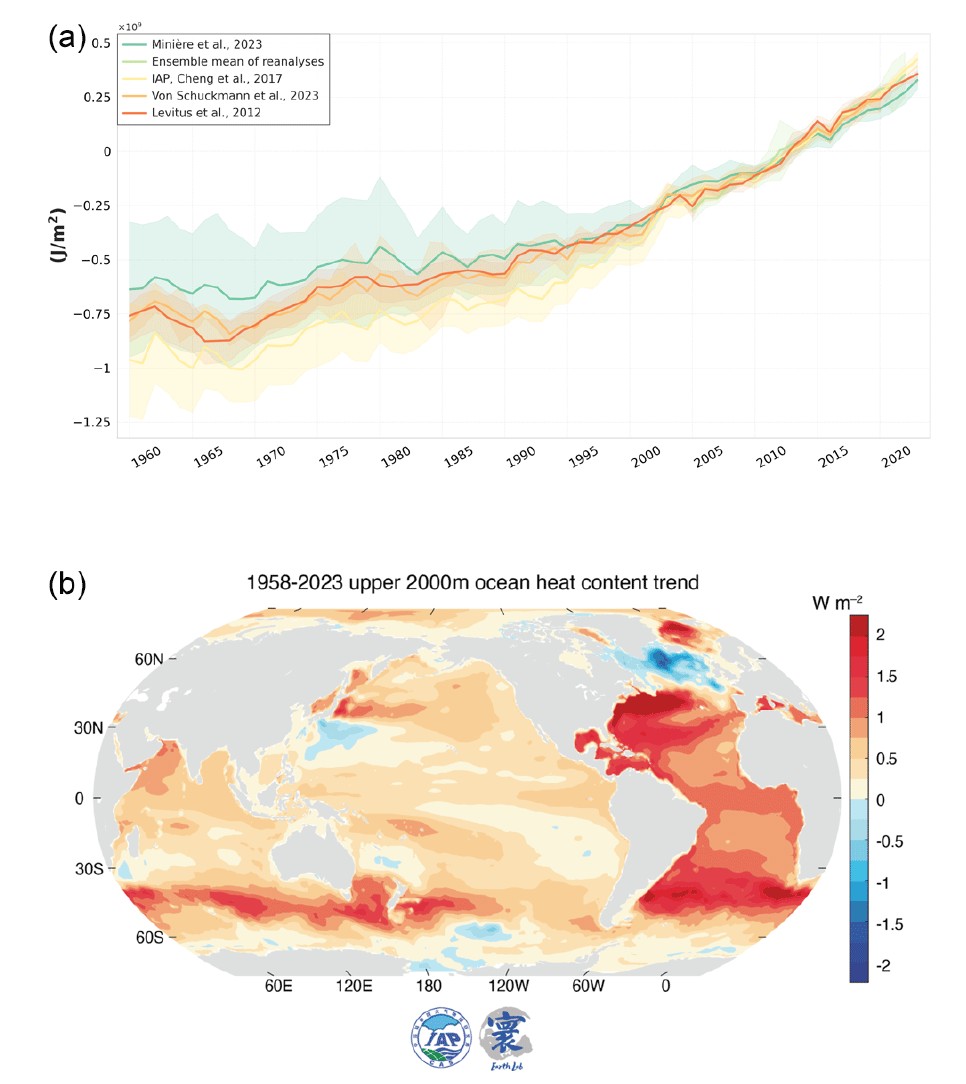
Source: von Schuckmann and others, 2024.
Note: (a) Global mean ocean heat content (60° S-60º N) integrated from the surface down to a depth of 2,000 m based on different products. Shaded areas indicate the uncertainty of each method. The trend is estimated using a locally weighted scatterplot smoothing approach and amounts to 0.58 ± 0.13 W m-2 over the period 1960-2023 and 1.05 ± 0.17 W m-2 over the period 2005-2023. (b) Regional trend in the period 1960-2023 for ocean heat content in the upper 2,000 m, in W m-2
…
2 Chemical trends
Ocean acidification
About 20 to 30% of the CO2 released by human activity into the atmosphere has been absorbed by the ocean, leading to an increase in the average surface ocean acidity of 0.1 pH units since pre-industrial levels. The transport of CO2 to the deeper ocean via currents and mixing has meant that ocean acidification now surpasses a depth of 2,000 m in the North Atlantic and Southern Oceans (IPCC, 2022). International initiatives such as the Global Ocean Acidification Observing Network are reporting large spatial and temporal variability in carbonate chemistry in the coastal zones as consequences of biological activity, water mixing and run-off from land. There is a large body of evidence reporting the negative impact of ocean acidification on marine species, ecosystems and their associated services (see sect. 4, chaps. 4 and 5). Species adaptation to changes in carbonate chemistry has been utilized as one of the representative stressors studied to understand species and ecosystem sensitivity Ref 46 in future marine conditions Ref 49.
Changes in carbon
The ocean is the second largest carbon reservoir on Earth at 37,300 GtC (1015gC) and holds over 60 times the carbon of the atmosphere Ref 9. Ocean CO2 uptake rates have tripled over the past 60 years to 2.7 ±0.3 PgC per year (over the period 1990-2019) and are expected to continue increasing by 0.4± 0.1 PgC per decade Ref 15. These values are affected spatially and interannually by shifts in weather and climate. It is expected that eventually the average net warming of surface waters will reduce ocean uptake rates due to the reduction in CO2 solubility at higher temperatures.
…