Welcome to DU!
The truly grassroots left-of-center political community where regular people, not algorithms, drive the discussions and set the standards.
Join the community:
Create a free account
Support DU (and get rid of ads!):
Become a Star Member
Latest Breaking News
Editorials & Other Articles
General Discussion
The DU Lounge
All Forums
Issue Forums
Culture Forums
Alliance Forums
Region Forums
Support Forums
Help & Search
Environment & Energy
Related: About this forumCrashing insect populations have resulted in smaller tree swallows that reproduce less
https://news.umich.edu/crashing-insect-populations-have-resulted-in-smaller-tree-swallows-that-reproduce-less/In bringing the role of biodiversity loss into better focus alongside climate change, researchers say that there may be opportunities to better protect wild birds
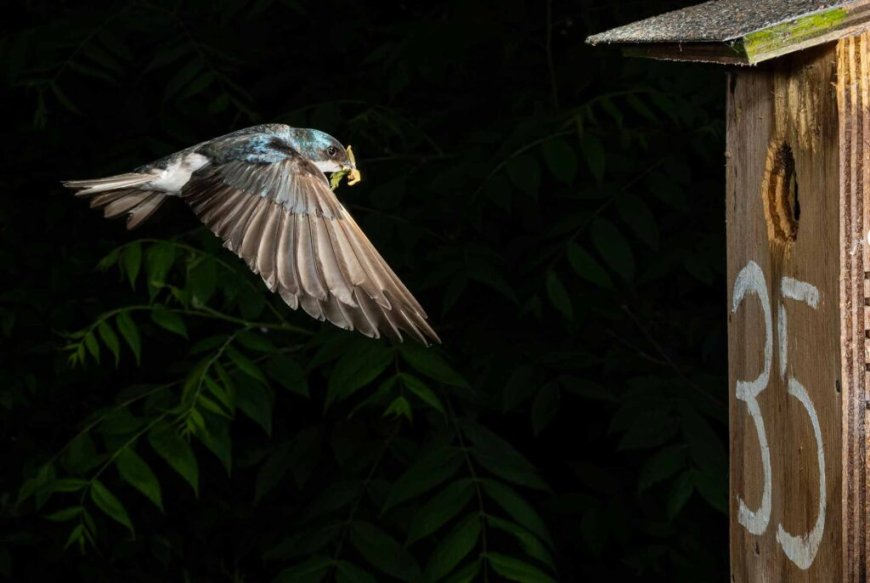
Tree swallows are uniquely suited for a study like this because they will return to nesting sites that researchers have set up for them. Researchers can also peek into nests to count eggs and band chicks without the parents abandoning the nest. Image credit: Sherri and Brock Fenton
June 25, 2026
Contact: Matt Davenport
Since the 1970s, the amount of insects at Canada’s Long Point Bird Observatory has dropped by more than 60%, according to a new study led by the University of Michigan. Because of this, today’s birds are smaller and facing greater challenges to their breeding success compared with previous generations.
The researchers focused on tree swallows, a rapidly declining bird species that feeds on flying insects.
“Tree swallow clutch size is really tightly tied to insect availability,” said Charlotte Probst, lead author of the new study and a doctoral student in the U-M School for Environment and Sustainability, or SEAS. “When there’s fewer insects available, the birds are smaller and the birds also produce fewer young.”
The study also integrates climate data, making it one of the first to consider the role of resource availability alongside climate change in understanding how these pressures are reshaping bird biology. The results show that climate impacts cannot be fully understood without considering biodiversity loss. In the case of tree swallows, finding ways to combat that loss outside of solving climate change could be reasons for cautious optimism, the team said.
…
C.M. Probst,S. Yanco,I. Clark,M. Ziebell,M. Fuirst,S.A. Mackenzie,I. Ibáñez, & B.C. Weeks, Resource declines shape phenological and morphological responses to climate change, Proc. Natl. Acad. Sci. U.S.A. 123 (26) e2607714123, https://doi.org/10.1073/pnas.2607714123 (2026).Tree swallows are uniquely suited for a study like this because they will return to nesting sites that researchers have set up for them. Researchers can also peek into nests to count eggs and band chicks without the parents abandoning the nest. Image credit: Sherri and Brock Fenton
June 25, 2026
Contact: Matt Davenport
Since the 1970s, the amount of insects at Canada’s Long Point Bird Observatory has dropped by more than 60%, according to a new study led by the University of Michigan. Because of this, today’s birds are smaller and facing greater challenges to their breeding success compared with previous generations.
The researchers focused on tree swallows, a rapidly declining bird species that feeds on flying insects.
“Tree swallow clutch size is really tightly tied to insect availability,” said Charlotte Probst, lead author of the new study and a doctoral student in the U-M School for Environment and Sustainability, or SEAS. “When there’s fewer insects available, the birds are smaller and the birds also produce fewer young.”
The study also integrates climate data, making it one of the first to consider the role of resource availability alongside climate change in understanding how these pressures are reshaping bird biology. The results show that climate impacts cannot be fully understood without considering biodiversity loss. In the case of tree swallows, finding ways to combat that loss outside of solving climate change could be reasons for cautious optimism, the team said.
…
4 replies
 = new reply since forum marked as read
Highlight:
NoneDon't highlight anything
5 newestHighlight 5 most recent replies
= new reply since forum marked as read
Highlight:
NoneDon't highlight anything
5 newestHighlight 5 most recent replies
= new reply since forum marked as read
Highlight:
NoneDon't highlight anything
5 newestHighlight 5 most recent replies
Crashing insect populations have resulted in smaller tree swallows that reproduce less (Original Post)
OKIsItJustMe
11 hrs ago
OP
Recently, I was hanging up the laundry at night and I found myself asking, "Where are the mosquitoes!?"
OKIsItJustMe
10 hrs ago
#2

Bayard
(30,706 posts)1. Our swallows didn't show up at all this year
We usually have a horde of them nesting in gourds. Very disappointing.

OKIsItJustMe
(22,434 posts)2. Recently, I was hanging up the laundry at night and I found myself asking, "Where are the mosquitoes!?"
"Where are the ‘June Bugs!?’"
Bayard
(30,706 posts)3. I don't think its quite june bug season here yet
As wet as it is here now though, still not seeing mosquitoes. Plenty of those damn Japanese beetles in the gardens though.
OKIsItJustMe
(22,434 posts)4. Now that i'm thinking about it
I don’t recall clouds of mayflies either.