Welcome to DU!
The truly grassroots left-of-center political community where regular people, not algorithms, drive the discussions and set the standards.
Join the community:
Create a free account
Support DU (and get rid of ads!):
Become a Star Member
Latest Breaking News
Editorials & Other Articles
General Discussion
The DU Lounge
All Forums
Issue Forums
Culture Forums
Alliance Forums
Region Forums
Support Forums
Help & Search
General Discussion
Showing Original Post only (View all)
Congress Is Trying to Permanently Integrate U.S. and Israeli Defense Tech [View all]
A proposal to entwine U.S. and Israeli tech in AI and autonomous systems is controversial — and closely resembles a pro-Israel bill that died earlier this year.https://theintercept.com/2026/06/08/us-israel-224-ai-defense-budget/
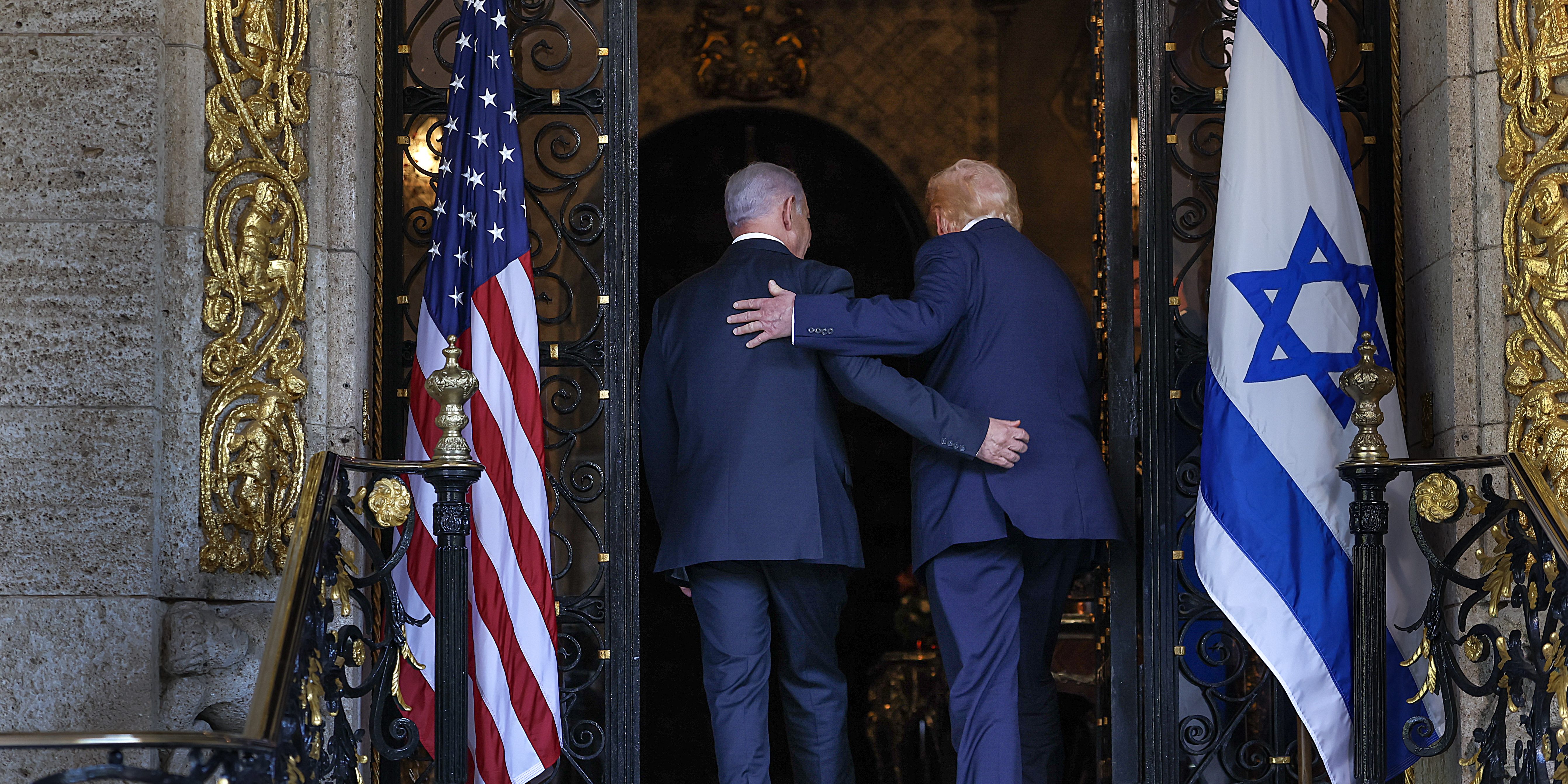
Donald Trump welcomes Benjamin Netanyahu to his Mar-a-Lago club on Dec. 29, 2025, in Palm Beach, Fla. Photo: Joe Raedle/Getty Images
A controversial insertion in the National Defense Authorization Act currently winding its way through the House would permanently intertwine U.S. and Israeli defense technology, including artificial intelligence and autonomous systems. Lawmakers and military experts told The Intercept that Section 224, named “United States-Israel Defense Technology Cooperation Initiative,” is highly irregular — and closely resembles a bipartisan bill backed by the pro-Israel lobby that died in Congress earlier this year. “I can’t think of another example of Congress formalizing integration of critical national security technologies with a foreign power,” said retired Air Force Lt. Col. William Astore.
Unlike traditional foreign military aid programs, Section 224 would establish a framework for integrating Israeli-developed technologies directly into U.S. research, procurement, manufacturing, and acquisition processes — which military experts warned would be complicated, if not impossible, to unwind. It would apply across areas including AI, autonomous systems, cyberwarfare, biotechnology, missile defense, and defense industrial production. Astore, who has taught military history at multiple institutions, said he’s particularly concerned about the AI component. “Israel is a leader in using AI predictive models and programs to surveil and kill people, using manned and unmanned drones,” he said. “The ‘smart,’ even autonomous technologies Israel has used against Palestinians could very well be used by the U.S. government against American citizens — especially the so-called radical left that President Trump appears to see as domestic terrorists.”
The debate is raging as Congress prepares to take up the fiscal year 2027 NDAA, a routine piece of legislation that spells out congressional priorities and budgeting for the armed forces. The House Armed Services Committee approved the legislation on Thursday evening; it now advances for consideration by the full House. A handful of legislators from both parties have rebuked Section 224. Among them is Rep. Thomas Massie, the Kentucky Republican known for opposing all foreign military aid — a stance that drew the ire of the American Israel Public Affairs Committee and drove millions in spending against him in the recent primary he lost to a Trump-backed challenger. Massie was quick to condemn the proposal before it moved forward, writing: “If the provision in the NDAA to integrate/synchronize the U.S. and Israeli militaries (section 224) makes it out of committee, I’ll offer an amendment to strip it from the bill on the floor.”
Rep. Ro Khanna, a California Democrat and Massie’s frequent collaborator, attempted to do something similar at the committee stage. On Thursday, Khanna introduced an amendment seeking to remove Section 224, arguing that Congress should not deepen military integration with Israel at a time when lawmakers are increasingly questioning the future of the U.S.–Israel relationship. But the amendment failed in committee after opposition from both Republicans and Democrats, including Armed Services Committee Ranking Member Adam Smith, D-Wash., who argued the U.S. benefits from access to Israeli military technologies developed under real-world combat conditions, citing missile defense, drone warfare, and other emerging capabilities as areas of mutual interest.
snip
4 replies
 = new reply since forum marked as read
Highlight:
NoneDon't highlight anything
5 newestHighlight 5 most recent replies
= new reply since forum marked as read
Highlight:
NoneDon't highlight anything
5 newestHighlight 5 most recent replies
= new reply since forum marked as read
Highlight:
NoneDon't highlight anything
5 newestHighlight 5 most recent replies
Congress Is Trying to Permanently Integrate U.S. and Israeli Defense Tech [View all]
Celerity
Tuesday
OP