https://woa.un.org/third-world-ocean-assessment/changes-second-world-ocean-assessment/chapter-3-trends-physical-and-chemical
…
1 Physical trends
Ocean temperature (including ocean heat content)
The great capacity of the ocean to capture and store heat moderates the temperature of the planet. Over 90% of the heat absorbed by the Earth since 1955 has been accumulated in the oceans. Figure I (a) illustrates the heat increase in the upper 2,000 m of the ocean since 1955 and shows a continuous rise that peaks in 2023 Ref 48. Some 16% of this increase occurred between 2018 and 2023 even though those years represent only 7% of the time period. This heat energy accounts for 30 to 50% of sea level rise in the ocean through thermal expansion. In addition, warming contributes to changes in the migration of oceanic species, damage to coral reef systems and the accelerated melting of ice sheets (see sect. 4, subchap. 5K; and subsect. 5B, chap. 4). While the Pacific Ocean holds the largest heat reservoir due to its vast size, the greatest warming has been observed in most of the Atlantic Ocean and in the parts of the South Ocean adjacent to the Indian and Western Pacific Oceans (see figure I (b)), with notable cooling regions observed in the North Atlantic (~ 50-70º N) and in the North-West and South-West Pacific Ref 6 Ref 48. The ocean surface is where the most important heat exchange between the ocean and the atmosphere occurs. Shifts in sea surface temperature translate to important differences in water evaporation rates, atmospheric heating and cooling, marine heat waves and the thawing of sea ice, in addition to broader impacts on continental climate, as discussed in the second World Ocean Assessment.
Figure I. (a) Global mean ocean heat content (0–2,000 m); (b) Regional trends of ocean heat content (0–2,000 m)
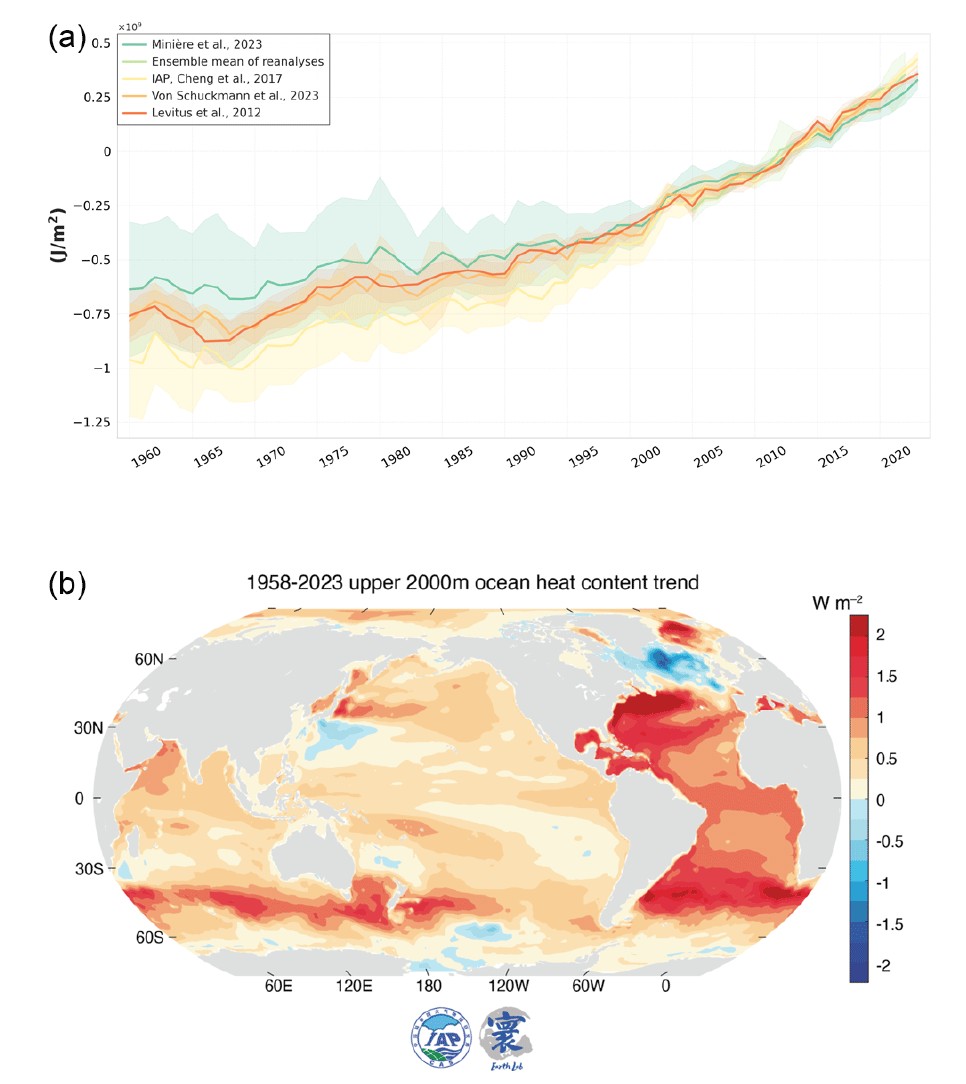 Source: von Schuckmann and others, 2024.
Note: (a) Global mean ocean heat content (60° S-60º N) integrated from the surface down to a depth of 2,000 m based on different products. Shaded areas indicate the uncertainty of each method. The trend is estimated using a locally weighted scatterplot smoothing approach and amounts to 0.58 ± 0.13 W m-2 over the period 1960-2023 and 1.05 ± 0.17 W m-2 over the period 2005-2023. (b) Regional trend in the period 1960-2023 for ocean heat content in the upper 2,000 m, in W m-2
…
2 Chemical trends
Ocean acidification
About 20 to 30% of the CO2 released by human activity into the atmosphere has been absorbed by the ocean, leading to an increase in the average surface ocean acidity of 0.1 pH units since pre-industrial levels. The transport of CO2 to the deeper ocean via currents and mixing has meant that ocean acidification now surpasses a depth of 2,000 m in the North Atlantic and Southern Oceans (IPCC, 2022). International initiatives such as the Global Ocean Acidification Observing Network are reporting large spatial and temporal variability in carbonate chemistry in the coastal zones as consequences of biological activity, water mixing and run-off from land. There is a large body of evidence reporting the negative impact of ocean acidification on marine species, ecosystems and their associated services (see sect. 4, chaps. 4 and 5). Species adaptation to changes in carbonate chemistry has been utilized as one of the representative stressors studied to understand species and ecosystem sensitivity Ref 46 in future marine conditions Ref 49.
Changes in carbon
The ocean is the second largest carbon reservoir on Earth at 37,300 GtC (1015gC) and holds over 60 times the carbon of the atmosphere Ref 9. Ocean CO2 uptake rates have tripled over the past 60 years to 2.7 ±0.3 PgC per year (over the period 1990-2019) and are expected to continue increasing by 0.4± 0.1 PgC per decade Ref 15. These values are affected spatially and interannually by shifts in weather and climate. It is expected that eventually the average net warming of surface waters will reduce ocean uptake rates due to the reduction in CO2 solubility at higher temperatures.
…

 = new reply since forum marked as read